


Desmond Morris (1928–2026)
Updated: May 3
Desmond Morris, zoologist, artist, broadcaster and one of the most influential interpreters of human behaviour of the last century, has died aged 98. For more than sixty years he urged us to look again at ourselves with curiosity, as animals whose habits, rituals and gestures deserved the same careful attention as those of birds, mammals or reptiles.
Morris’s great gift was to make the familiar strange. He viewed human beings precisely as he had once viewed animals in a field, zoo or laboratory: as members of a species whose everyday actions were rich with evolutionary meaning. He refused to accept that custom alone explained behaviour, arguing instead that biology quietly shaped our postures, preferences, passions and fears.
Over a life that spanned nearly a century, Morris produced more than fifty books, alongside hundreds of television programmes, scientific papers and artworks. His accessible style inspired generations of writers, psychologists, artists and body‑language enthusiasts.
From early childhood Morris exhibited what would become his defining trait: insatiable curiosity. Educated at Dauntsey’s School in Wiltshire, he made his first professional breakthrough as a schoolboy, publishing an article in Natural History Magazine based on his observations of toads. He earned five shillings, which he immediately spent on books - “A reaction,” he said, “that I must confess has persisted throughout my writing career.”
That hunger to observe may also have been shaped by loss. His father was killed by wounds received in the First World War, leaving Morris with a lifelong discomfort about how humans treated one another, a discomfort that later fuelled his desire to understand the roots of aggression.
As a teenager, he dated Diana Fluck - later famous as Diana Dors - who taught him to dance and kiss. Morris never lost sight of the personal, sensual dimension of behaviour, but he would later analyse it with the cool eye of an ethologist.
Morris studied zoology at the University of Birmingham but refused to conduct animal experiments, turning instead to ethology (the objective study of behaviour). He later completed a doctorate at Oxford, studying bird reproduction, before joining figures such as Niko Tinbergen and Konrad Lorenz at the forefront of behavioural science.
From the beginning, Morris refused to separate science from art. In 1957 he exhibited paintings by chimpanzees at the Institute of Contemporary Arts in London, and maintained a lifelong dual identity. His Oxford home would later be divided into two halves (art and science):
“It’s like two hemispheres of my brain.”
Morris became a familiar face to millions through Granada Television’s Zoo Time, which ran from 1956 to 1967. Broadcasting direct from a studio built in London Zoo (a privilege not afforded his friend David Attenborough), he was toppled by a tortoise, urinated on by a lion, attacked by a scorpion, and mauled by a bear cub.
These risks only increased the programme’s appeal. Granada, sensing a rival to Attenborough, had found its man.
In 1967 Morris published The Naked Ape, a book that detonated into global culture. Subtitled A Zoologist’s Study of the Human Animal, it sold tens of millions of copies and reframed Homo sapiens as simply one primate among many — albeit a hairless, socially complex one.
“Man is a risen ape, not a fallen angel,” he said.
Morris applied Darwinian logic to sex, aggression, family life and social hierarchy. Humans were social carnivores, torn between biology and culture. Copulation, he argued, was not merely reproductive but bond‑forming — a mechanism for pair‑attachment.
The backlash was fierce. Christians burned copies. The Vatican banned the book. Feminists criticised its hunter‑gatherer assumptions. Yet Morris insisted he was not degrading humanity:
“I like animals and I feel proud to call myself one.”
If The Naked Ape startled readers into noticing themselves, Manwatching taught them how to look. Writing and travelling extensively — more than 280 trips to 76 countries — Morris refined a method of observing posture, gesture, clothing and spacing as communicative signals.
A friend once remarked: “You look at people the way a bird‑watcher looks at birds.”
“Yes,” Morris replied, “you could call me a man‑watcher.”
The extraordinary success of The Naked Ape transformed Morris’s life materially as much as intellectually. For a time, he embraced the freedom that money allowed. He relocated with Ramona and their young son Jason to Malta, bought a Rolls‑Royce, acquired a 30‑foot cabin cruiser, and settled into a handsome villa overlooking the Mediterranean. The island appealed to his eye and his sense of human theatre, even though strict censorship meant Maltese citizens were not legally allowed to read the very book that had made him wealthy. Morris would later acknowledge that the spending spree was exuberant but finite; when the money ran out, he returned calmly to academic life, curiosity intact and undiminished.
Returning to Oxford as a research fellow at Wolfson College, Morris continued to write prolifically. The Human Zoo explored modern cities as artificial habitats that distorted ancient social instincts; The Soccer Tribe analysed football as a ritualised form of territorial conflict and male bonding; Bodywatching systematised non‑verbal communication; while later books such as Dogwatching, Babywatching and Christmas Watching extended his ethological method to other species, childhood development and even seasonal ritual.
He remained fascinated by Mediterranean gesticulation, football crowds, male arena displays, synchronised chanting, ritualised aggression and courtship posture. To Morris, a shrug, crossed arms or leaning stance mattered as much as speech. The body, he argued, rarely lied even when words did.
“If there were a Nobel Prize for gesticulation,” he joked, “a Neapolitan would win it.”
In later years, books such as Postures: Body Language in Art brought his two great interests together, showing how stance, tilt, tension and balance communicate power and emotion across centuries of painting.
After the death of his wife Ramona in 2018, Morris moved to Ireland to be closer to their son Jason. His curiosity never faded. He wrote: “I developed – I still possess – an insatiable urge to see every aspect of human activity.”
Desmond Morris taught us that to understand ourselves, we must first have the courage to watch ourselves — honestly, patiently, and without illusion.
My Top 5 Desmond Morris Books (in order)
Peoplewatching: The Desmond Morris Guide to Body Language (2002, UK edition)
A revised and expanded synthesis of Manwatching and Bodywatching, presenting Morris’s most accessible and comprehensive guide to human non‑verbal behaviour.

Bodywatching (1986)
A detailed analysis of the human body as a signalling system, examining posture, movement, anatomy and physical display as evolved communication tools.
Manwatching: A Field‑Guide to Human Behaviour (1979)
A breakthrough book that treats everyday human actions - gestures, clothing choices, personal space — as if observed in an unfamiliar animal species.
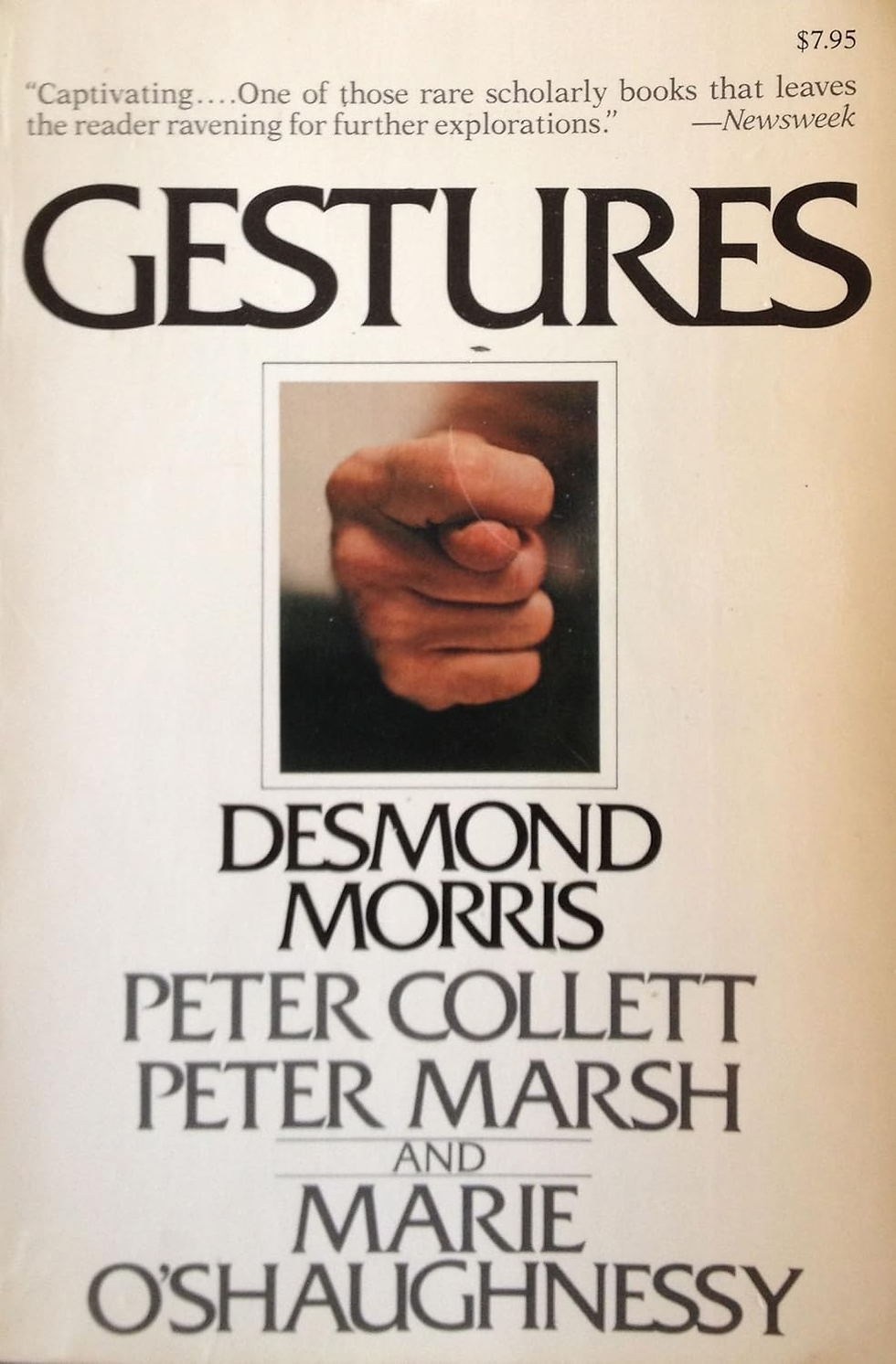
Gestures: Their Origins and Distribution (1979)
A scholarly, cross‑cultural investigation into the biological roots, meanings and geographical variations of human gestures.
Postures: Body Language in Art (2019)
A richly illustrated study showing how artists across history have used stance, weight, balance and gesture to convey authority, emotion and social status.

Some of Morris’ Key Human‑Watching Insights
1) Humans are signalling animals (often without realising it)
Morris frames people as constant broadcasters: status, intention, mood, affiliation, attraction, threat - expressed through visible acts more than declared beliefs. Watch for: what the body “announces” before the person speaks - orientation, distance, gaze, touch.
2) The body is a communication system (a “catalogue” of signals)
In Manwatching, he treats behaviour as a readable system - actions become gestures; gestures carry messages - and he categorises them systematically rather than romantically. Watch for: repeatable signal families (gaze, greeting, mirroring, self‑touch, barriers, threat, etc.).
3) Not all actions are learned: some are inborn, some copied, some trained
A distinctive Morris lens is how behaviours are acquired - inborn, discovered, absorbed from peers, trained by culture, or mixed. Watch for: whether a movement looks reflexive (hard to suppress) or stylised (socially taught).
4) Gesture types: from shared “animal” gestures to culturally symbolic ones
He distinguishes gestures that are biologically expressive (shared across animals) from those that are schematic/symbolic/coded (culture-built). Watch for: “big” universal emotions vs. local “sign language” gestures that can flip meaning across cultures.
5) Gaze behaviour is a primary status + intention channel
Morris gives gaze its own treatment: staring, glancing, looking away - all functioning as social steering and dominance/avoidance cues. Watch for: who looks first, who breaks first, and whether gaze is “checking” (quick, repeated) or “holding” (possession/status).
6) “Salutation displays”: greetings are ritualised social negotiations
Hello/goodbye behaviours are not trivial - they’re rituals that manage access, confirm rank, and reduce uncertainty. Watch for: intensity of greeting, distance, touch permission, and who initiates/ends contact.
7) Postural echo (mirroring) signals affiliation
Morris explicitly labels postural echo: friends (and allies) often synchronise without noticing. Watch for: matched tempo (nod rhythm, leaning angle, leg cross timing) rather than exact copying.
8) “Tie‑signs”: bonding is displayed, not just felt
One of his most durable contributions is the idea of tie‑signs - visible signals that say “we belong together.” He also separates body‑contact tie‑signs (touch) from non‑touch forms. Watch for: small public permissions - shared space, light guiding touch, inside jokes, coordinated movement.
9) Auto‑contact (self‑touch) reveals internal management
Morris treats self‑touch as “self‑intimacy”: people regulate arousal, uncertainty, or social strain by touching face, hair, hands, clothing. Watch for: spikes in self‑touch at decision points, conflict moments, or when someone is “on display.”
10) Nonverbal leakage: the body gives you away
He highlights “leakage” as the unintended tells that escape conscious control. Watch for: brief posture collapses, micro‑freezes, sudden barrier creation, or changes in foot direction.
11) Contradictory signals matter more than single signals
Morris explicitly names contradictory signals - when channels disagree (smile + retreat; friendly words + blocked torso). Watch for: the “stronger” channel—usually body orientation, distance, and movement - over polite speech.
12) Status displays are everywhere (not just in obvious dominance)
He devotes attention to status displays as a core behavioural layer. Watch for: claiming space, interrupting rhythms, leading movement, occupying central positions, and who adapts to whom.
13) Territorial behaviour + barriers: invisible boundaries made visible
Morris treats territory as behavioural: people create barriers (objects, arms, bags) to manage access and threat. Important correction/upgrade: the classic “intimate/personal/social/public distance zones” are most strongly associated with proxemics research (not uniquely Morris), but Morris popularised territorial reading for everyday life. Watch for: how quickly someone rebuilds a barrier after it’s removed; feet pointing “home” (exit) vs “toward” (engagement).
14) Displacement activities: stress leaks into “irrelevant” actions
Morris includes displacement activities - fidgeting, grooming, rearranging items—when competing motives collide (e.g., want to engage vs want to escape). Watch for: behaviour that has no practical goal but rises with social pressure.
15) Ritualisation: modern life is filled with stylised leftovers
A core Morris habit is explaining today’s routines as ritualised versions of older survival/social functions. Watch for: formalities that look “pointless” but stabilise hierarchy/belonging (greetings, ceremonies, team rituals).
16) Crowds behave like tribes (super‑organism logic)
In The Human Zoo, he argues cities force a tribal animal into an unnatural habitat, and people invent coping mechanisms for dense, stranger‑heavy living. Watch for: crowd synchrony—chanting, colours, shared rhythms—reducing individuality and amplifying identity.
17) Sport crowds as “tribal theatre”
In The Soccer Tribe, Morris applies his tribal lens to football fandom - why symbols, chants, uniforms, and rituals matter so much. Watch for: costume, face paint/colours, synchronised sound, and “us vs them” boundary behaviour.
18) Clothing and adornment amplify biology rather than replace it
Morris treats clothing/cosmetics as signal amplifiers—they intensify contrasts, reshape silhouettes, and exaggerate movement cues. Watch for: design choices that enlarge shoulders/legs/height, increase facial contrast, or control the way the body moves.
19) Cross‑cultural variation: gestures travel badly
He wrote entire works cataloguing gesture meaning across countries, showing that some signals are widely shared while others are locally “dialected.” Watch for: when confidence exceeds knowledge - misread gestures are a common social error in travel and multicultural teams.
20) Frontality and “display”: humans read faces intensely (and design signals around that)
Morris repeatedly pushes the idea that human social life relies heavily on face‑to‑face reading - and that appearance cues often function as high‑visibility signals in social/romantic contexts. He also made provocative arguments about visual mimicry in cosmetics and sexual signalling (widely discussed, sometimes contested). Watch for: how often interaction “locks” into face‑orientation; how quickly meaning shifts when someone turns their torso away.

Final tips & thoughts:
Read clusters, not single gestures. Morris catalogues signals, but meaning comes from patterns (orientation + distance + gaze + hands).
Track change over time. Leakage and contradiction show up as shifts - not as static “tells.”
Separate universal from cultural. Basic emotional expressions are often broadly readable; emblem gestures can be region‑specific.
Remember Morris can be speculative. His evolutionary “just‑so” explanations are part of his style and impact, but not all are equally accepted today


Comments